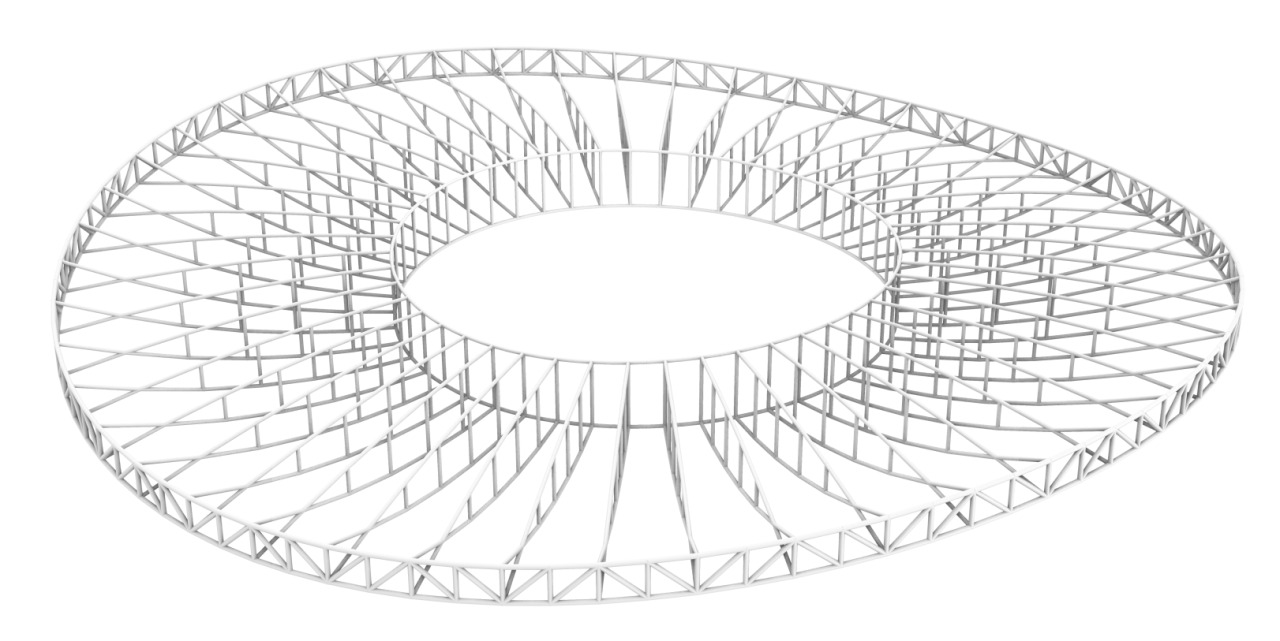
In contrast to rigid structures, conventional cable net, cable-stayed and cable-suspended structures are tensile systems that are only stabilised by tension with zero compression and bending rigidity. Numerous functional benefits such being aesthetically-pleasing and lightweight with a freeform nature are always favoured by designers and engineers alike. ADAS® TensiNet System integrates a series of compressive strut members into these structural systems. This hybrid system is not only able to cover a larger span and bigger area but also enhances the system rigidity to create potential savings in material costs.
Unique design capabilities
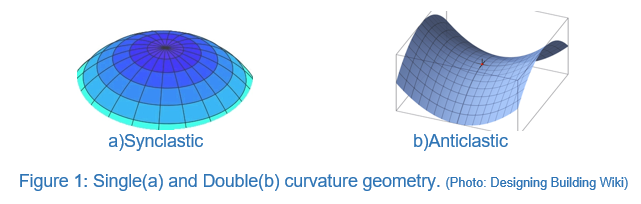
By having flexibility and rigidity as the main perk, ADAS® TensiNet System structures are able to have a wider range of shapes and topologies. These systems are commonly formed with single curvature (synclastic) and double curvature (anti-synclastic) tensile surfaces as shown in Figure 1, the latter resulting in a much stiffer structure than the former. This allows for surface tensioning and deformation without much deviation from its design form. In addition, cables allow for various design patterns such as parallel, orthogonal or radial arrangements in conjunction with a single layer or double layer nets as shown in Figure 2.
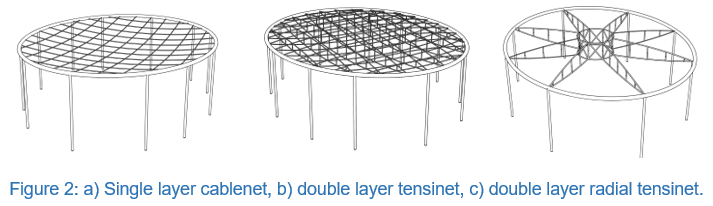
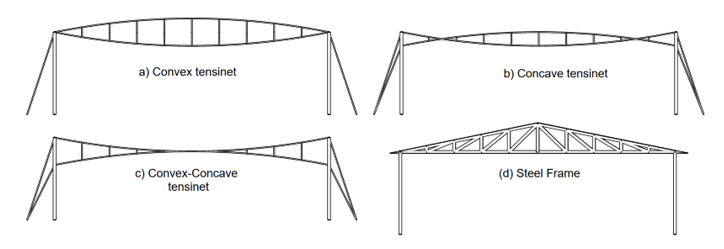
ADAS® TensiNet System serves as the primary supporting element to the roof system. This element highly depends on the structure shape, span and design criteria. Several patterns of tensinet arrangements are generally used in practice and are usually stabilised by an external compression ring, ie. a single layer tensinet (Figure 2a) while a double layer tensinet (Figure 2b) is further pretensioned by compressive struts. The radial tensinet (Figure 2c) derives from the concept of the spoke wheel principle. Unlike typical fully-covered roofs, this design improves the direct lighting into the space by only requiring an inner tension ring for stabilisation and no bulky intermediate steel. Their final geometry always results in concave, convex or even combination of both forms as shown in Figures 3a, b, and c.
In particular, tensinet systems are able to replace conventional steel frames as shown in Figure 3d with any of the systems resulting in a total 30% savings in material cost with the same dimensions. In addition to the light material usage, an optimised design is achieved by orienting the pretensioned cables to minimize the force transfer to the supports anchored at the end span of the structure. The challenges in designing tensinet structures arise from their active changing shape which requires advanced computing and analysis in simulating their geometrical nonlinear behaviour.
ADAS® TensiNet System is integrated with various types of fabric roof systems such as ADAS® Tensile Membrane and ADAS® ETFE Skylight. Due to different compositions of the fabric material, they exhibit different physical properties such as heat resistance, shading coefficients and tensile strength, which allow them to be customisable to suit various requirements and applications. Both systems result in a column-free space with minimum material usage while admitting maximum natural light.
By Phey – November 6, 2020