
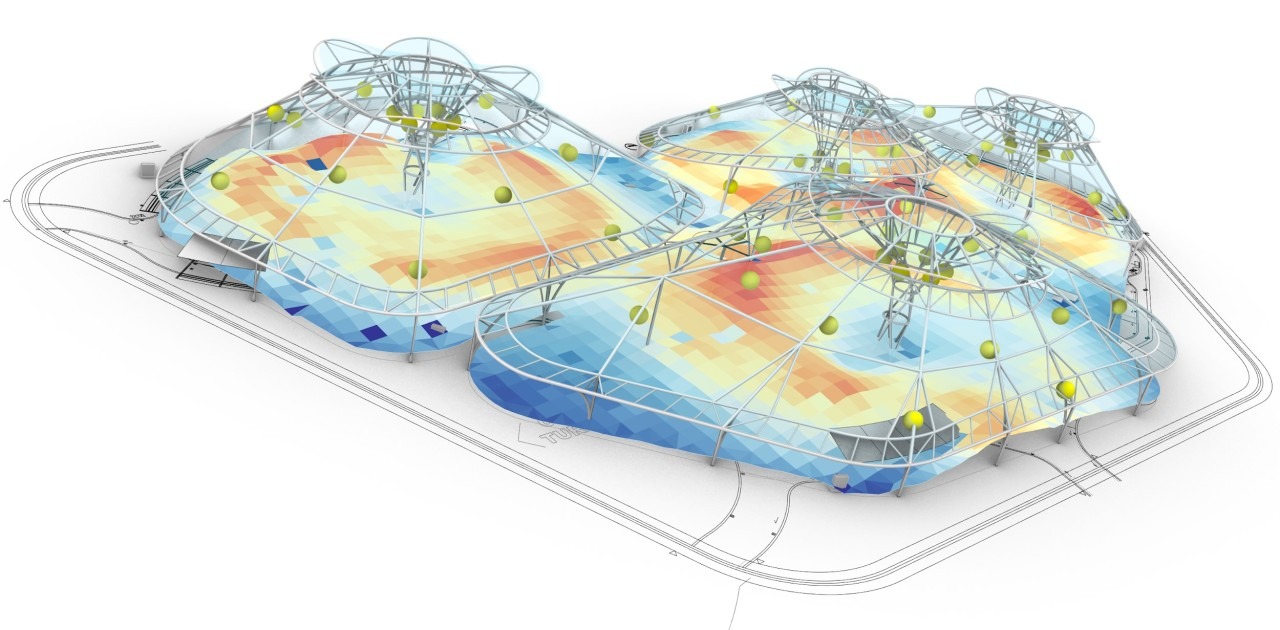
As our projects grow in size, the coverage of our ADAS® Tensile Membrane structures grows too. As a result, this is often followed by fewer natural lighting opportunities.
Relying on natural daylight to support the activities happening below is sometimes insufficient for this type of huge structure, such for the case study shown in Figure 1 which covers 10,500 sqm. Thus, artificial lighting is required to keep the illuminance performance within acceptable comfort levels. This is especially important for public spaces with night operational hours.
In order to address this issue, our team can perform ADAS® Advanced Analysis to find the right balance for your illumination needs. Using state-of-the-art computational analysis tools, we can carry out lighting design to achieve lighting performance levels that comply with available standards while minimizing energy consumption.
Efficient Lighting Solutions
In our workflow, we incorporate important factors such as lighting type, power consumption, lighting position, tilting, and the illumination profile. These factors will determine the quality of the spatial illumination.
Based on these variables, we iterate the design until certain lighting qualities such as lux value, illumination distribution, and glare probability are achieved. The cases might be differ across various project types and goals. For example, the lighting distribution requirements of a parking lot will not be the same as the requirements for a drop-off canopy, or the minimum lux value needed inside a storage room compared to under a courtyard. The lighting goals to be achieved depend on the activity of each space.
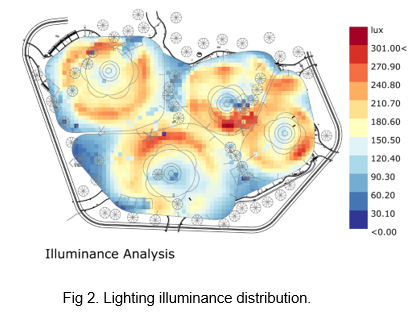
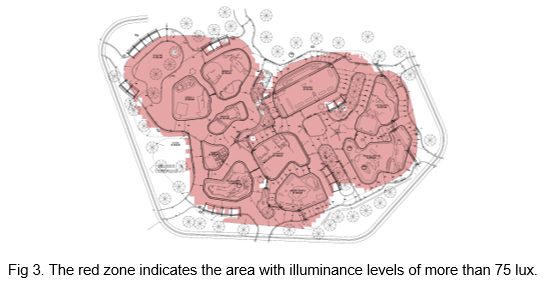
Below are examples of the analysis results we produced for one of our projects (Figure 2). Our performance target was for the pedestrian ways to be lit with a minimum of 75 lux (Figure 3). This number was determined based on the standards for outdoor public spaces. In order to reach this criteria, we tried to play with lighting positions, along with tilting and direction, based on the steel structure of our membrane canopy. We also had to consider site constraints such as existing buildings and trees.
Visual Comfort
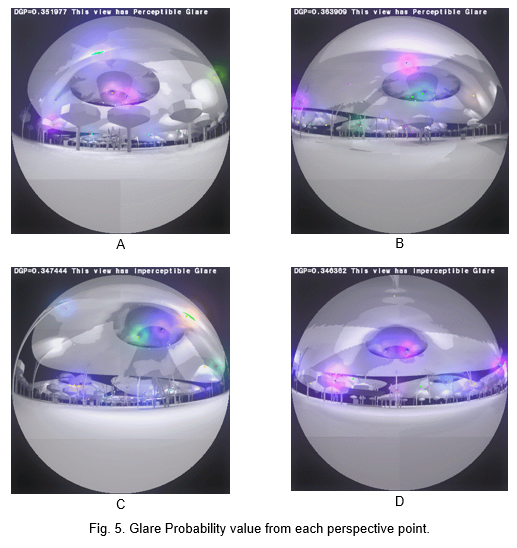
Aside from illuminance levels, we also incorporated the Daylight Glare Probability (DGP) index into the lighting design. The space should not only be bright enough for human activity, but also be within a comfortable range.
According to acceptable standards (Wienold, 2018), the index value of the DGP should not be more than 0.38. Above that value, the glare levels will be considered disturbing to the human eye. Based on this performance benchmark, we tested several potential vulnerable points to assess whether the lighting performance was within the acceptable range.
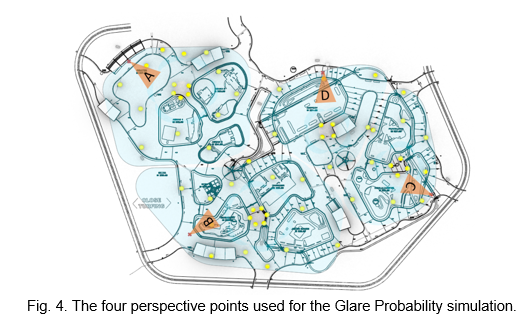
Below are examples of glare analysis from the same project. We tested the glare potential using four perspective points facing the center of the structure (Figure 4). The results show that at eye level, there are no DGP values above 0.38 (Figure 5).
The case study above is an example of the many environmental studies we carry out as part of ADAS® Advanced Analysis. Based on the results, we were able to gain more insight into the lighting performance of our design. Our team always strives for better data-driven decision making; the more data we acquire, the better our planning will be. Our ADAS® Advanced Analysis workflow will enrich us with data that can help clients find the right balance between efficiency and comfort.
References
Wienold, J. (2018). Correspondence: Investigation of Evalglare software, daylight glare probability and high dynamic range imaging for daylight glare analysis. Lighting Research & Technology, 50(2), 329-330. doi:10.1177/1477153518758612.
By Irfan – August 27, 2020