
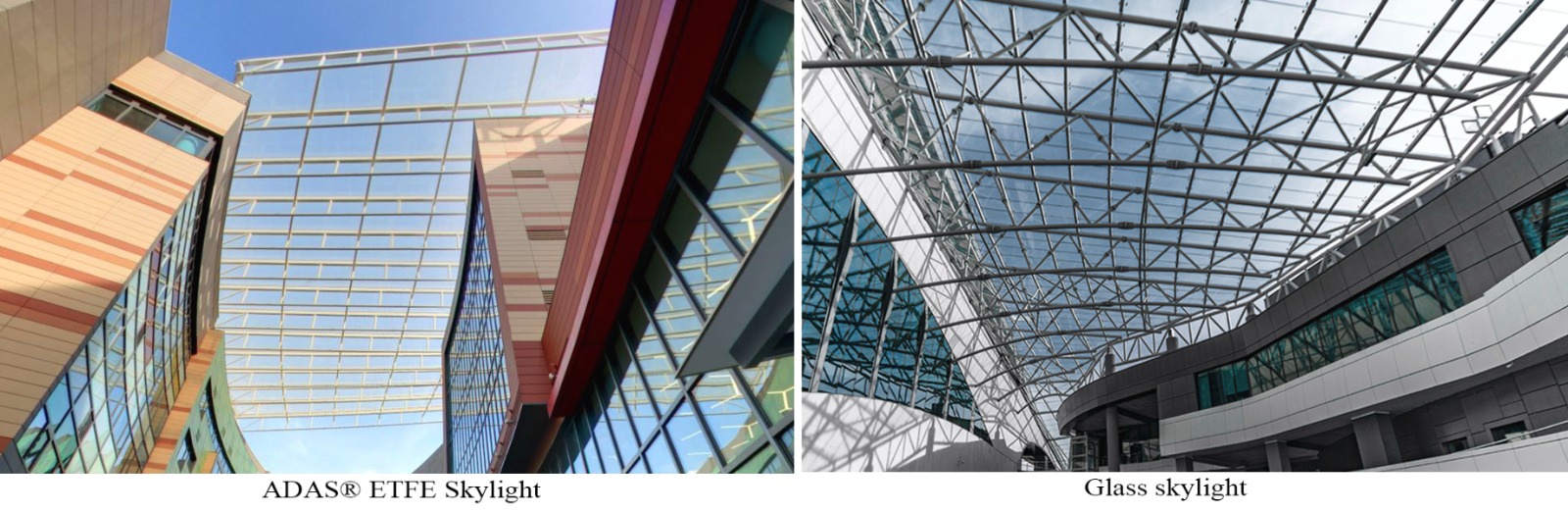
Ethylene tertrafluoroethylene (ETFE) film is one of the most promising building materials due to its attractive mechanical, chemical and thermal properties. Not only is ETFE film super lightweight and durable, it is also an eco-friendly material with 100% recyclability.
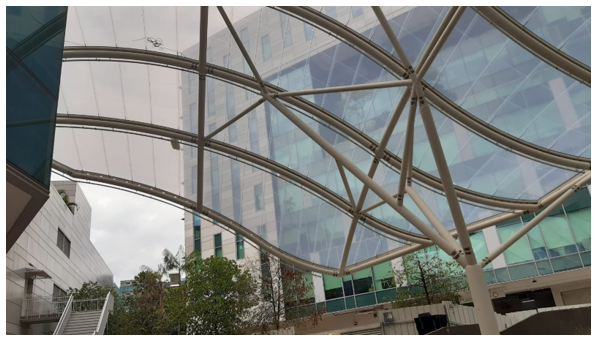
As a transparent material that has exceptional light transmission, insulation and solar control performance, ETFE is being increasingly used by designers and builders as an alternative to structural glass. To understand the advantages of ETFE film over structural glass, a comparison of material properties between ETFE and structural glass will be explored in this article.
Mechanical Properties
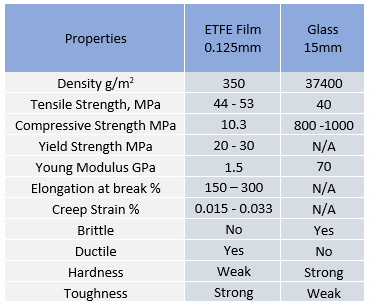
Although ETFE has lower compressive strength than glass, the ductile nature of ETFE allows it to have superior impact strength (high toughness), along with abrasion and cut-through resistance. This property allows ETFE to deform and absorb greater impact energy as compared to structural glass. Furthermore, glass is an amorphous solid (brittle) that shatters when a large force is exerted on it, which make it dangerous to use in roof skylights.
ETFE has low creep strain under a constant stress of 2MPa [1] which is proof of its durability. Additionally, a low coefficient of friction means that any dust or dirt that lands on ETFE film can be easily washed away by rainwater, greatly reducing the need for maintenance and cleaning. Inert chemical properties of ETFE make it unreactive to the weathering and chemical attacks, thus further increasing the durability of ETFE.
As a result, the ADAS® ETFE Skylight is a comparatively safer and hassle-free solution for building structures.
Thermal & Light Transmittivity Properties
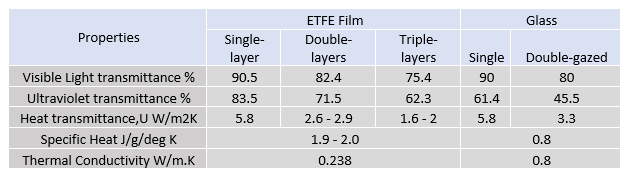
Experimental data obtained from various studies [2][3][4] indicate that ETFE film can have better light transmittivity than glass, allowing large amounts of natural light into buildings and greatly reducing energy consumption. Utilization of a cushion system in ETFE structures enhances the insulation properties of the material, whilst still providing good translucency. The shading effectiveness of double-layer ETFE cushions compared to single layer ETFE can be seen in the following ADAS® ETFE Skylight project.
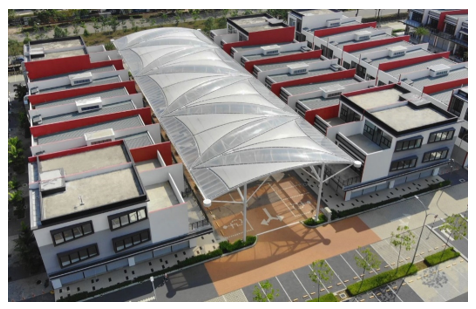
In terms of heat retention, a double-layered ETFE cushion structure provides a lower U value which is superior to that of double-glazed glass. Glass also carries an increased risk of thermal breakage under partial heating or cooling, due to its low thermal conductivity and brittleness.
Overall, an ADAS® ETFE Skylight will outperform any other transparent material system in terms of mechanical strength, chemical resistance and thermal properties.
Sources:
1.https://www.fluorotherm.com/technical-information/materials-overview/etfe-properties/
2.https://www.makmax.com/business/etfe_advantages.html
3.https://www.saint-gobain-sekurit.com/glossary/glass-properties
4.Experimental Assessment and Thermal Characterisation of Lightweight Co-Polymer Building Envelope Materials
By Jeong Han – May 13, 2020