As a result of design, fabrication and logistical planning, the installation of ADAS® Tensile Membrane structures is one of the final milestones in achieving good quality lightweight tensile structures. The vital aspects of installation that we look into include the quality consistency, safety, and time consumption. If the installation process is lousy and unsafe, this would affect the quality of the end product and the design intent of the tensile structure would fail to meet client and designer expectations.
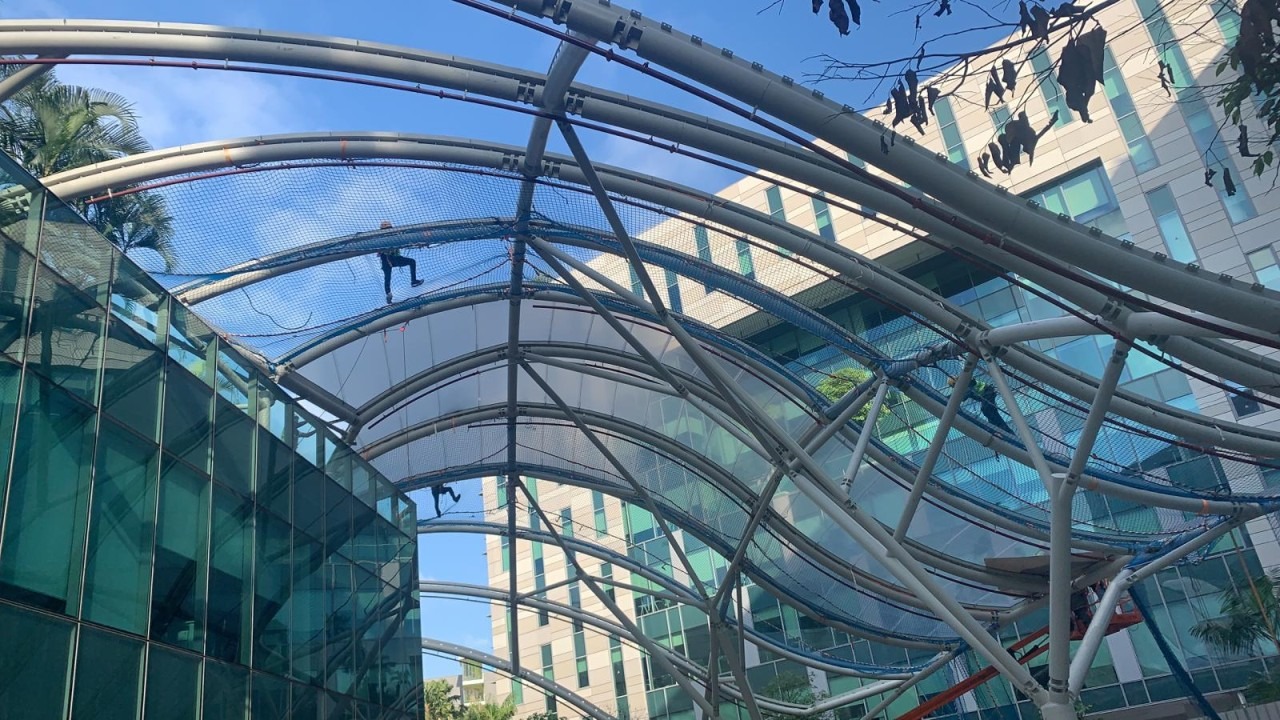
Generally, as ADAS® Tensile Membrane projects usually pertain to roofing, canopies and facades, the installation process involves Work at Height (WAH). The working platform selected needs to suit the complexity of the roofing or façade geometry and be able to deploy professionals to their ideal position with ease. Scaffolding could be an option, but depending on the site constraints and given project duration, rope access with temporary working platforms can be a better choice for experienced professionals, for a few reasons:
- The diversity & flexibility of netting as a working platform that can be installed along the profile of the proposed membrane
- Light weight and compactness in transportation compared to the heavy scaffolding elements
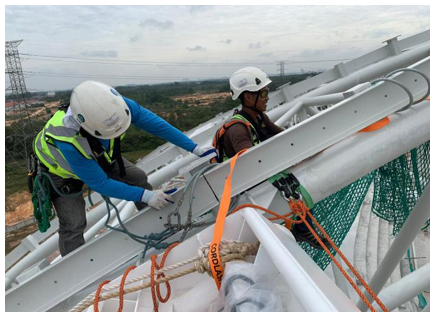
- Trust in the hands of the Positional Safety Harness (IRATA)
In lightweight tensile structures, steelwork and tensile fabric are the two most important components. For typical projects that we handle, the ADAS® Tensile Membrane installation process is as follows:
Steelwork Check/ Calibration
Connection details of the membrane to steel or secondary steel members are always the main point of concern for ADAS® professionals when a new project comes to hand. Preliminary checks against shop drawings in terms of welding quality, finishing coats, quantities and placement of brackets/flat bars takes place as preparational work prior to the actual deployment of the ADAS® Tensile Membrane. Rectification to steelwork may be required if necessary.
ADAS® Temporary Working Platform Installation
For ADAS®, ‘Temporary Working Platform’ is used as a general term during installation; its content varies depending on the individual project characteristics. Netting, Ratchet Straps and Ropes are the most common items in our professionals’ checklists. Their specifications will be based on our installation assessment by each project team, and tailored to project needs, such as structural spans, height, and membrane dimensions.
The Temporary Working Platform will be assembled in a designated location, normally underneath the proposed ADAS® Tensile Membrane structure, by IRATA-certified rope access professionals with positional safety harnesses.
Membrane Unpacking & Unfolding
Our ADAS® Tensile Membranes will arrive at the site via a standard air freight container for our overseas projects all around the world. A standard unpacking and unfolding procedure is practiced strictly by the ADAS® project team on site to orientate each membrane in a manner that matches the intent of the unfolding plan.
ADAS® Tensile Membrane Tensioning
ADAS® Tensile Membrane shall be tensioned carefully according to our in-house analyzed System-Line to achieve the designed form. The exact tensioning process and sequence essentially boils down to the interpretation of control parameters, like the ambient temperature, material and geometry of the tensile membrane, and intensity of sunlight exposure, which in turn rely on our in-house desk-study and site judgement base on professional experience.
The continued development of our installation process and the pursuit of excellence in project execution are a guarantee of ADAS® Tensile Membrane’s quality and fulfillment of value in every project.